



 Download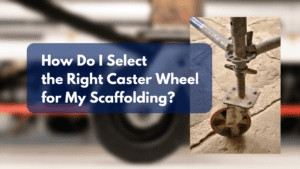
Scaffolding is a temporary structure that is supported by its scaffolding equipment. The equipment may be a base plate or a caster wheel, but it should be robust enough to bear the weight of the entire scaffolding and the scaffold users. That’s why picking the right set of scaffolding caster wheels is of utmost importance.
The scaffold caster not only gives the 3D structure a base but also lets the scaffold move around. The wheels can be locked, and the erected scaffold can be used. The casters are inserted into the static scaffold tube to simultaneously make it mobile and secure. This will facilitate a variety of construction projects in the vertical plane and on uneven surfaces. The worker will be able to relocate the scaffolding without difficulty.
This blog will elaborate more on how to choose a caster wheel and its benefits.
What are caster wheels?
A caster (or caster) is an unpowered wheel designed to be attached to the underside of a larger object (the “vehicle”) in order to facilitate its movement. In numerous industrial applications, such as platform trucks, carts, assemblies, scaffolding, and tow lines in plants, high-capacity, heavy-duty casters are utilized.
In scaffolding, the caster wheels are attached to the bottom of the scaffolding to help it move around the worksite.
What are the selection criteria for scaffold casters?
1. Select the appropriate size caster
The larger the diameter of the caster, the more labor-efficient and resistant it is to obstacles.
Scaffold casters are typically available in sizes from 5 to 12 inches. Smaller wheels around 5 to 6 inches suit lighter, indoor mobile scaffolds, while larger 10 to 12 inch casters are better for heavier loads and rougher outdoor job site surfaces, since bigger wheels roll over obstacles with less effort.
2. Select an appropriate material
Casters are categorized as super synthetic rubber casters, polyurethane casters, plastic casters, nylon casters, steel casters, high-temperature casters, rubber casters, etc. Casters made of various materials are used in various ground conditions and temperatures, and they must be selected based on the application.
3. Determine the load-bearing mass
For identical-diameter mobile scaffolding casters with varying load-bearing requirements, the manufacturer typically produces multiple models, primarily to produce wheels and brackets with varying thicknesses or materials. When the terrain is relatively flat, the single caster load equals the number of casters installed on the equipment divided by 1.2 (the insurance factor).
4. Choose the bracket
The two types of brackets are orientation and universal direction. Typically, the material is carbon steel. In addition to stainless steel, you can get various types of plating, such as spraying, galvanizing, copper plating, nickel plating, etc.
5. Determine the method of installation
Typically, you can use a screw rod, plunger, expansion rubber sleeve, etc. for a moderate to light load. Use the bottom plate or have the caster directly welded to the equipment for heavy loads.
6. Breaking and locking mechanism
Functionally, brakes are typically divided into brake wheels and universal brake brackets. There are also friction brakes, positive brakes, side brakes, etc. Caster brakes must be effective. When workers are on scaffolding, they must stay put. Workers could fall if it keeps rolling, swiveling, or moving.
Most scaffolding casters have an easy-to-access braking mechanism that anyone can kick into place to prevent movement while working. Scaffolding needs a locking mechanism, too. Once the scaffolding is up, make sure it doesn’t move by itself. A locking mechanism is needed to keep scaffolding in place while workers do tedious work above it.
What are the benefits of a scaffold caster?
1. Mobility
Scaffolds with casters are ideal for moving. All tradesmen and industrial maintenance workers can do their jobs quickly and easily without needing a large scaffold or manual conversions. So, scaffolds can be moved and secured flexibly in different areas.
2. Safety
Regarding securing casters on scaffolding, safety is of the utmost importance. Because they promote motion, wheels and casters reduce physical strains and demands on employees when moving large loads. With the addition of a braking mechanism, the safety features are enhanced.
3. Scaffold caster wheel capacity
Casters have the advantage of being able to support the considerable weight without breaking. As a result of the caster wheel‘s rotation around an axle and bearing race, it is subjected to significantly less direct pressure than a conventional wheel. Because the wheel turns instead of the chassis, its load-bearing capacity is significantly greater than that of a conventional wheel.
Scaffold caster safety measures
Scaffoldings are prone to accidents and mishaps if proper caster safety precautions are not observed. Follow these guidelines to avoid unwelcome occurrences:
- Avoid overloading the scaffolding. The casters will have to bear the additional weight, and they will buckle if the weight exceeds their capacity.
- Do not drop heavy loads on casters, as the initial impact can cause them to degrade and may also cause structural damage.
- Do not roll the scaffolding at a high rate of speed, as it can injure people and cause damage to any obstacles in its path.
- Always lock the scaffold caster wheel in place when it is not necessary for the scaffolding to move. If it begins to move without your permission, accidents may occur.
- Ensure that you immediately tighten any loose components of the casters.
FAQ
1.What is the full form or meaning of a caster wheel?
A caster wheel is an unpowered wheel attached to the underside of equipment, such as scaffolding, carts, or machinery, to allow it to be moved easily. It differs from a standard wheel in that it’s typically mounted on a swiveling or fixed bracket rather than a fixed axle.
2. How much weight can a scaffold caster wheel hold?
Load capacity depends on the caster’s size, material, and bracket design. Larger diameter casters made of steel or high-density polyurethane generally support heavier loads than smaller or softer-material wheels.
3.Can I replace just one caster wheel on my scaffold, or should I replace all of them?
It’s best to replace scaffold casters in matching sets rather than individually. Mismatched wheel diameters or materials can cause uneven rolling and added strain on the frame.
4. What’s the best caster wheel material for outdoor construction sites?
Polyurethane or rubber caster wheels are generally preferred outdoors since they offer better shock absorption and durability than harder materials like nylon or plastic.
Wrapping Up
A caster is a non-powered wheel designed to be attached to the underside of a larger object and used to move it. Attached to the base of device-moving equipment, caster wheels provide mobility for these objects. They make it possible to move heavy objects with less force. Caster wheels require routine maintenance to extend their service life.
AAIT is a scaffolding company in Houston that has rich experience with advanced techniques. We provide relevant information with the best solution. We make sure that our 12-inch caster wheels meet safety regulations and can bear a maximum load. This ensures that your scaffold’s framework will be sturdy and robust.
Request your estimation today!

Comments are closed